

Hawzah News Agency- In the interview, he discussed the ongoing conflict between Iran on one side and Israel and the United States on the other, as well as Iran-Bosnia and Herzegovina relations and the two countries' standing and leadership in cultural and artistic fields.
The full text of the interview follows:
You were a member of the interim leadership council after the martyrdom of Ayatollah Seyyed Ali Khamenei. How was the decision-making process in the council's meetings, and what was the most difficult issue you faced at that time?
After the assassination of the Leader of the Islamic Revolution, we faced a new experience in the post-victory era of the Islamic Revolution; an experience different from all our previous ones. The Leader of the Revolution was martyred and a number of commanders were also assassinated; as a result, some pillars of the country's governance were weakened.
At that same time, what drew our attention and was very important to us was the reaction of the people and ordinary citizens, who immediately took to the streets in support of their system and their homeland.
Another point was that our martyred Leader had made the necessary preparations before his martyrdom to preserve the continuity of power and the continuation of the country's administration. This was a very important matter. He had also defined the path for continuing the path of resistance.
These three factors together helped prevent the collapse of our country, and this is a point that must be emphasized.
Regarding the interim leadership council, I must say that this council was formed immediately after the martyrdom — or to put it more precisely, the assassination — of the Leader of the Revolution, and over those few days it made decisions regarding the administration of the country's affairs.
Do you support negotiations with Washington? Can this path lead to stability in the Middle East?
Iran has always adhered to dialogue and negotiation. What Donald Trump has done — and perhaps even worse than war itself — is that he has destroyed the dignity and credibility of negotiation at the global level; because on two occasions, when we were in the negotiating stage, he attacked our country. So, through these actions, he has effectively undermined the standing and credibility of negotiation at the global level.
Iran has therefore never rejected dialogue and negotiation; of course, it has always emphasized the need to preserve and respect the rights of the people. Iran, both during the conflicts and after them, has consistently stressed its readiness to continue resistance and steadfastness with the aim of defending the rights of the Iranian nation.
Those who attacked our country, by committing their crimes, including treason against humanity; because in the first days of the war, in a single attack, they martyred a large number of students at a school. This is just one of these cases.
Moreover, they officially demanded that our country surrender and bow down. They also openly threatened to destroy a civilization with thousands of years of history. In other words, with these threats they crossed all humanitarian red lines.
There is another point here as well: this attack was not directed solely at Iran; its consequences and damage spread to other parts of the world as well. Even European countries faced the consequences of these actions and the war imposed on Iran in their own region.
We did not start the war; but when it comes to self-defense and protecting the rights of our nation, we recognize no red lines and are prepared to use our maximum capacity to defend these rights.
Europe is expected not to follow the United States and the Zionist regime in their actions.
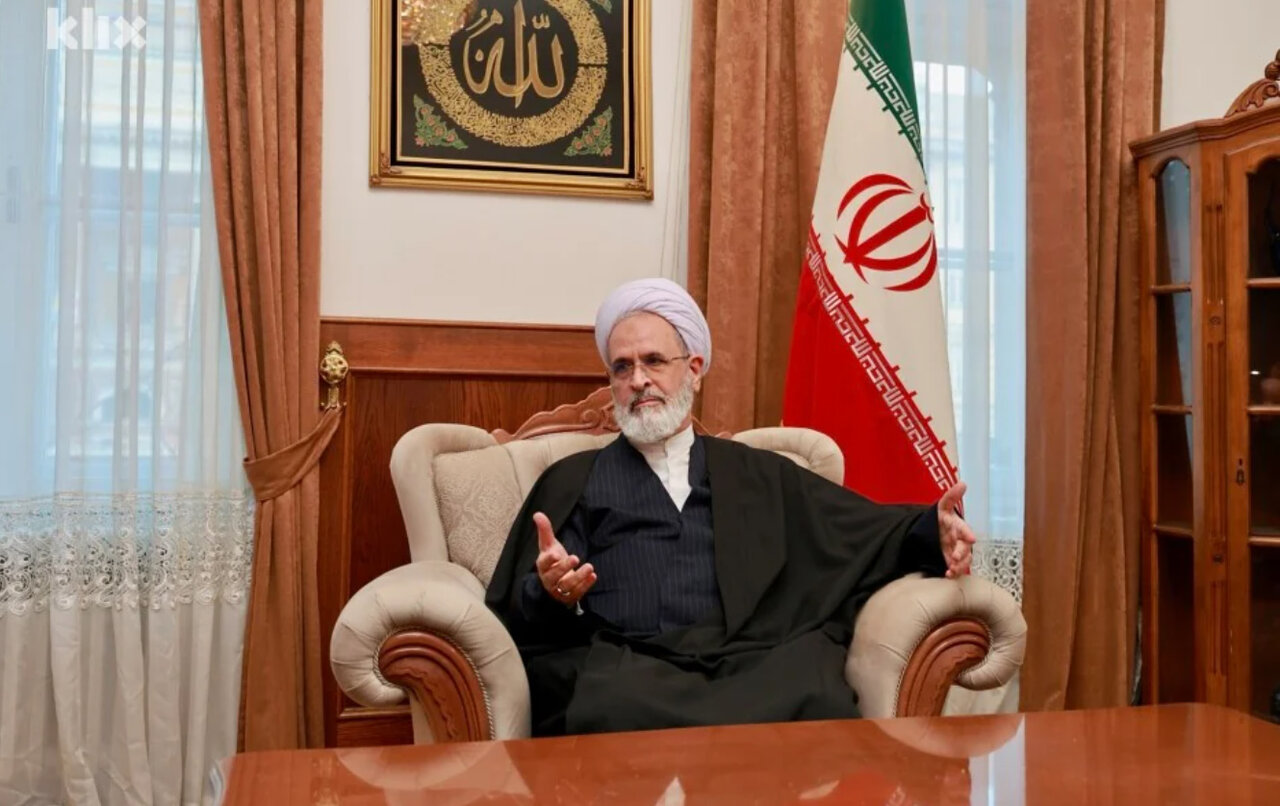
Is this your first visit to Bosnia and Herzegovina? How does Iran today view Bosnia and Herzegovina and the Muslims of the Balkan region? What kind of relations would you like to establish with a country like ours?
Over the past few years, I have traveled to the Balkan region and your country once or twice. Our relations with this region are full of similarities and many common points, which are more prominent especially in the cultural sphere.
My current visit to Bosnia and Herzegovina was made at the invitation of the country's Islamic Community and with the aim of participating in the charter ceremony for the new head of the Islamic Community of Bosnia and Herzegovina. We hope this visit will also contribute to the development of relations between our two countries; especially in cultural, intellectual, and ideological fields, as well as in the field of art.
Let me emphasize once again that Iran is seeking to strengthen and expand its relations with all countries in your region and, consequently, with all nations living in your country. We hope to see even better and stronger relations in the future.
This visit also carries the message that our country, as in the past, remains ready to deepen, develop, and improve its relations with your country in all fields.
How is the Bosnian war and the Srebrenica genocide remembered in Iran, especially among religious scholars? Are these subjects taught in religious schools and seminaries?
Iran, from both a humanitarian and an Islamic perspective, considers it its duty to rush to the aid of the deprived and oppressed wherever injustice and crimes against humanity occur anywhere in the world. This approach has always existed; after the victory of the Islamic Revolution, this was the case first in Afghanistan, then in Gaza and other regions. Iran has therefore always considered helping the needy and oppressed a religious duty.
We continue to view Bosnia and Herzegovina and its people with special affection. As I mentioned earlier, we seek the continuation and development of our relations with your country.
The Persian language and poetry, from Rumi to Hafez, have been present in Bosnia for centuries, and many manuscripts of Persian works are kept in the libraries of Sarajevo. Today, what factors bind Iran and Bosnia and Herzegovina together?
In addition to the field of literature, particularly in the field of poetry, language, and matters related to the spiritual dimensions of this field, I believe that grounds for cooperation can also be created and developed in the field of philosophy.
Furthermore, there is another important field, and that is literature, particularly resistance literature; because you too have gone through a period of resistance, and we have also been through this experience. Therefore, I believe that grounds for joint cooperation can be provided in this area as well.
On the other hand, our ambassador here is fully prepared to develop relations and cooperation in all these fields. Through institutions and educational centers inside Iran, we also declare our readiness to expand this cooperation.


Your Comment